The Method/Entry 1.02/One technique, and what it can and cannot carry
Multilocus probes
The first probes read many sites at once and produced a barcode-like pattern that was powerful for identity and very hard to interpret in a mixture.
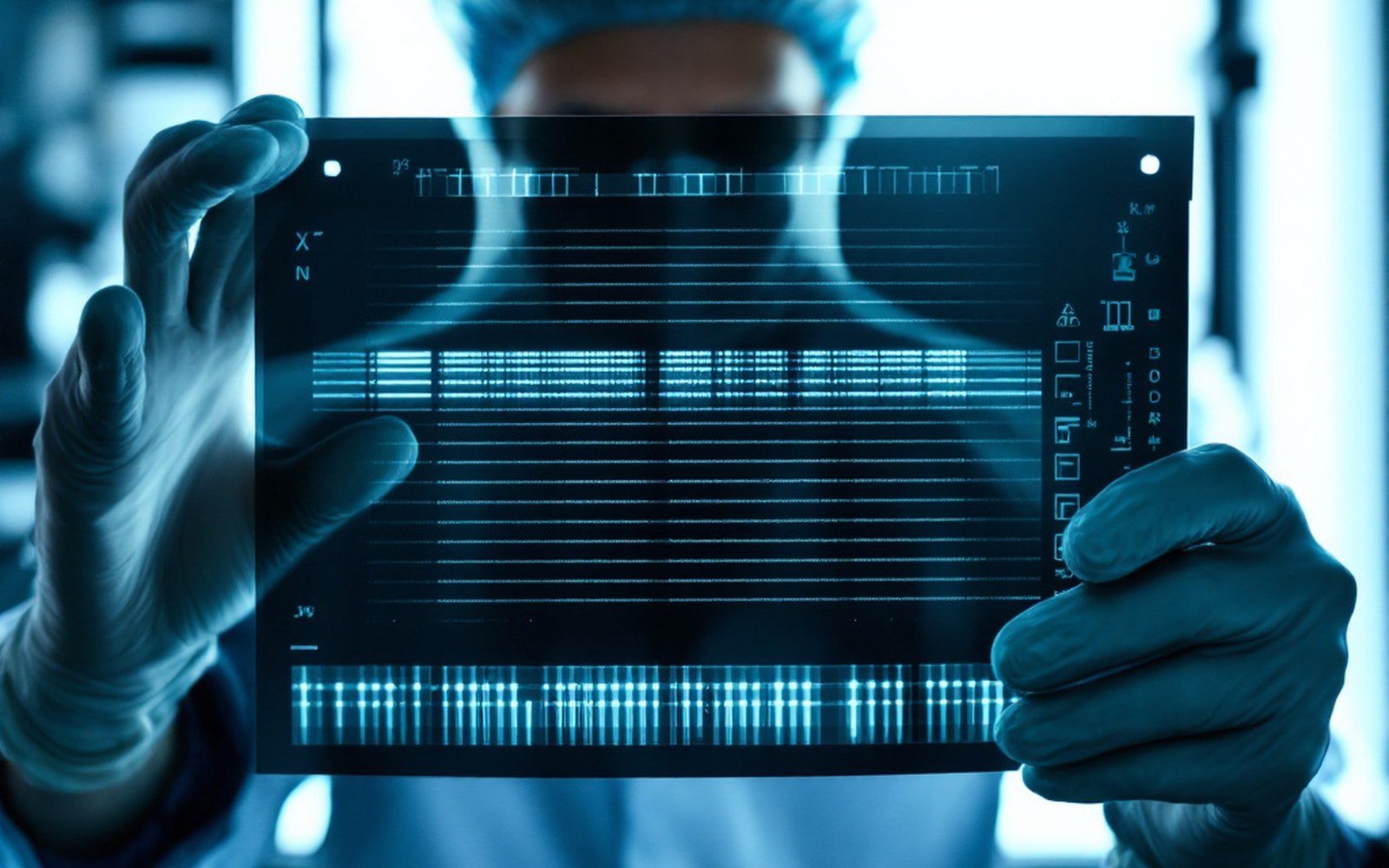
The original DNA fingerprint was a barcode read all at once — powerful, dramatic, and almost useless the moment two people's DNA appeared on the same membrane.

One probe, many sites
When Alec Jeffreys and his colleagues at the University of Leicester ↗ published their landmark 1985 Nature paper, the technique they described used a single radiolabelled probe that annealed to dozens of locations scattered across the genome simultaneously. Each location harboured a variable-number tandem repeat — a short sequence repeated end-to-end a different number of times in different individuals — and the probe lit up every one of them at once. Run the resulting fragments through a gel, transfer them to a nylon membrane by the method Edwin Southern had described a decade earlier, and the autoradiograph that emerged showed a dense ladder of dark bands. Jeffreys named the pattern a DNA fingerprint ↗, a label that captured its power and, unfortunately, its limits in equal measure.
The resolving power was genuine. Any two unrelated individuals share so few bands in identical positions that the probability of a coincidental match across a full multilocus pattern was, under the assumptions of the time, vanishingly small. For paternity testing and immigration disputes — where the question was simply whether two known samples matched — the multilocus probe was transformative. It gave caseworkers a visual answer they could photograph and file.
From the register
Key concepts in this piece
- Multilocus probe
- a radiolabelled probe hybridising to many variable sites at once; produces a multi-band autoradiograph
- Variable-number tandem repeat (VNTR)
- the repeating sequence the probe detects; length varies between individuals
- Single-locus probe
- successor method targeting one VNTR locus per hybridisation; interpretable in mixtures
- RFLP (restriction fragment length polymorphism)
- the underlying technique: DNA cut with restriction enzymes, fragments sorted by length
- Hybridisation
- the binding of a labelled probe to its complementary sequence on the membrane
The problem was mixture. A band pattern derived from two contributors is not the sum of two readable fingerprints; it is an overlapping tangle in which bands from one person may obscure, mask or be mistaken for bands from another. There is no clean way to subtract one contributor's pattern from the mess and read what remains. Forensic samples — touch deposits, blood in soil, swabs from complex scenes — are rarely from a single source, and the multilocus probe offered no reliable path through the tangle.

The transition to single-locus probes
The field's response was methodological. Rather than reading thirty or forty sites at once, laboratories began using probes targeted at a single locus — one variable region — and running separate hybridisations for each. A single-locus probe produces two bands per individual (one from each chromosomal copy), a pattern simple enough to read even when two contributors are present, provided their band sizes differ enough to resolve on the gel. Four or five such probes in sequence could still build a profile with compelling discriminating power, while keeping each step interpretable.
Jeffreys's own laboratory moved in this direction, and by the late 1980s the single-locus approach had largely displaced multilocus probes in casework. The FBI Laboratory adopted single-locus RFLP protocols, as did the forensic science services in Britain and across much of Europe. The multilocus probe did not disappear immediately — it remained in use in some immigration and paternity contexts where mixtures were not the concern — but its role in criminal investigation narrowed sharply.
From the register
Chronology of the transition
- 1985Jeffreys et al. publish the multilocus DNA fingerprint in Nature
- Mid-1980ssingle-locus probes developed as a casework-ready alternative
- Late 1980sFBI Laboratory and UK Forensic Science Service adopt single-locus RFLP protocols
- Late 1980s–early 1990sPCR enters routine use; STR analysis begins displacing RFLP methods
- 1990smultilocus probes effectively retired from criminal casework
Both approaches shared the same fundamental constraint: they required a sample large enough and intact enough to produce hybridisable high-molecular-weight DNA. The minimum was typically in the range of tens of nanograms, and degraded samples, where the long DNA strands had broken into shorter fragments, simply failed to produce interpretable bands. When PCR amplification arrived as a routine laboratory tool in the late 1980s, following Kary Mullis's development of the polymerase chain reaction, the gel-and-probe era began its long retirement. Short tandem repeat analysis, run through capillary electrophoresis and capable of working with picogram quantities of degraded DNA, was a different order of sensitivity altogether.
What the multilocus probe established, and what persists in every system that followed it, is the core logic: identity is a statistical argument built from variation at multiple independent sites, and the strength of that argument depends on how many sites are read and how variable each one is across the population. The barcode image is gone. The principle underneath it is what a profile still is.