The Instruments/Entry 5.03/One technique, and what it can and cannot carry
The capillary array
A bundle of fine tubes and a detector window, replacing a slab of gel.
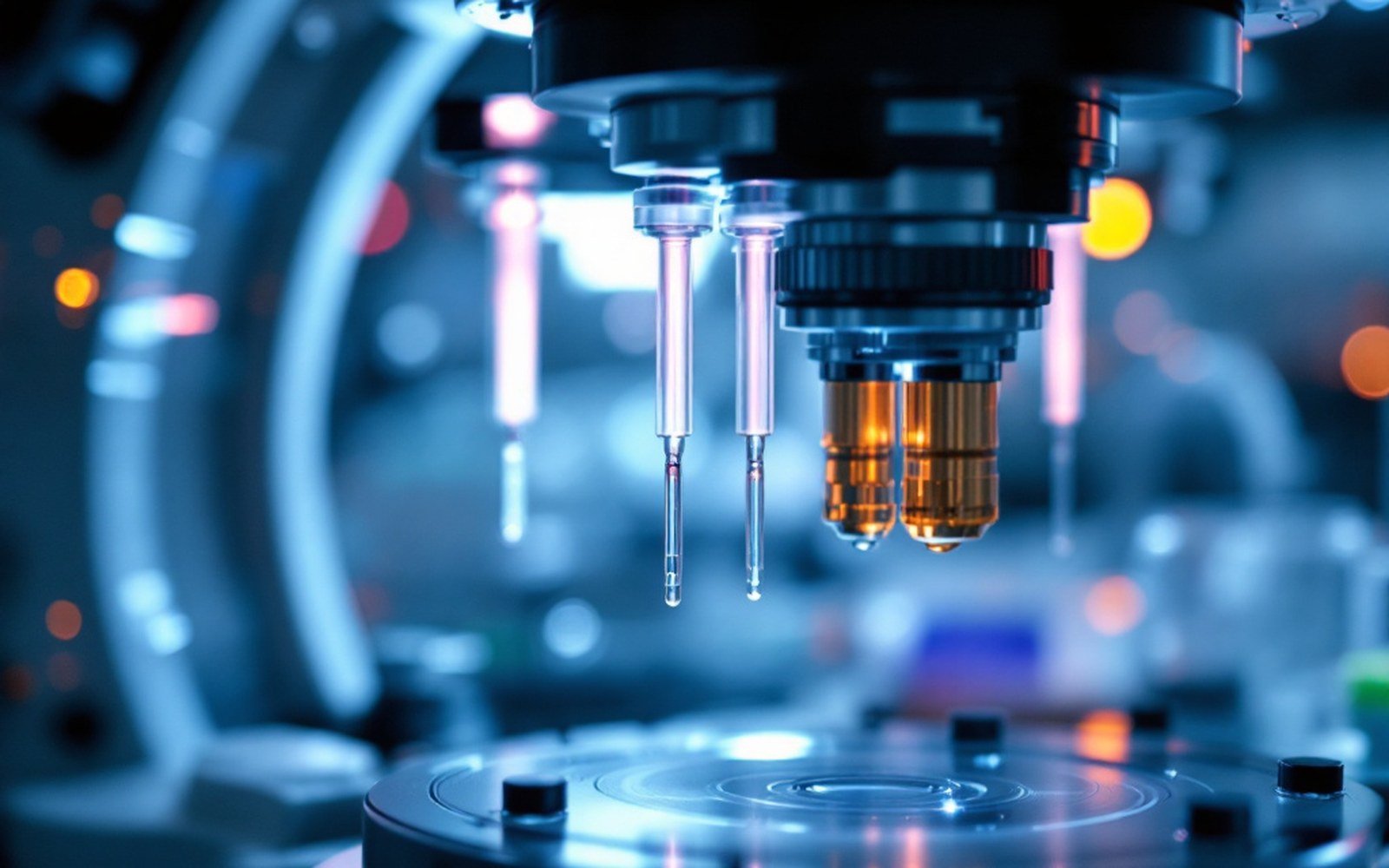
A bundle of thin tubes that replaced an afternoon of gel work
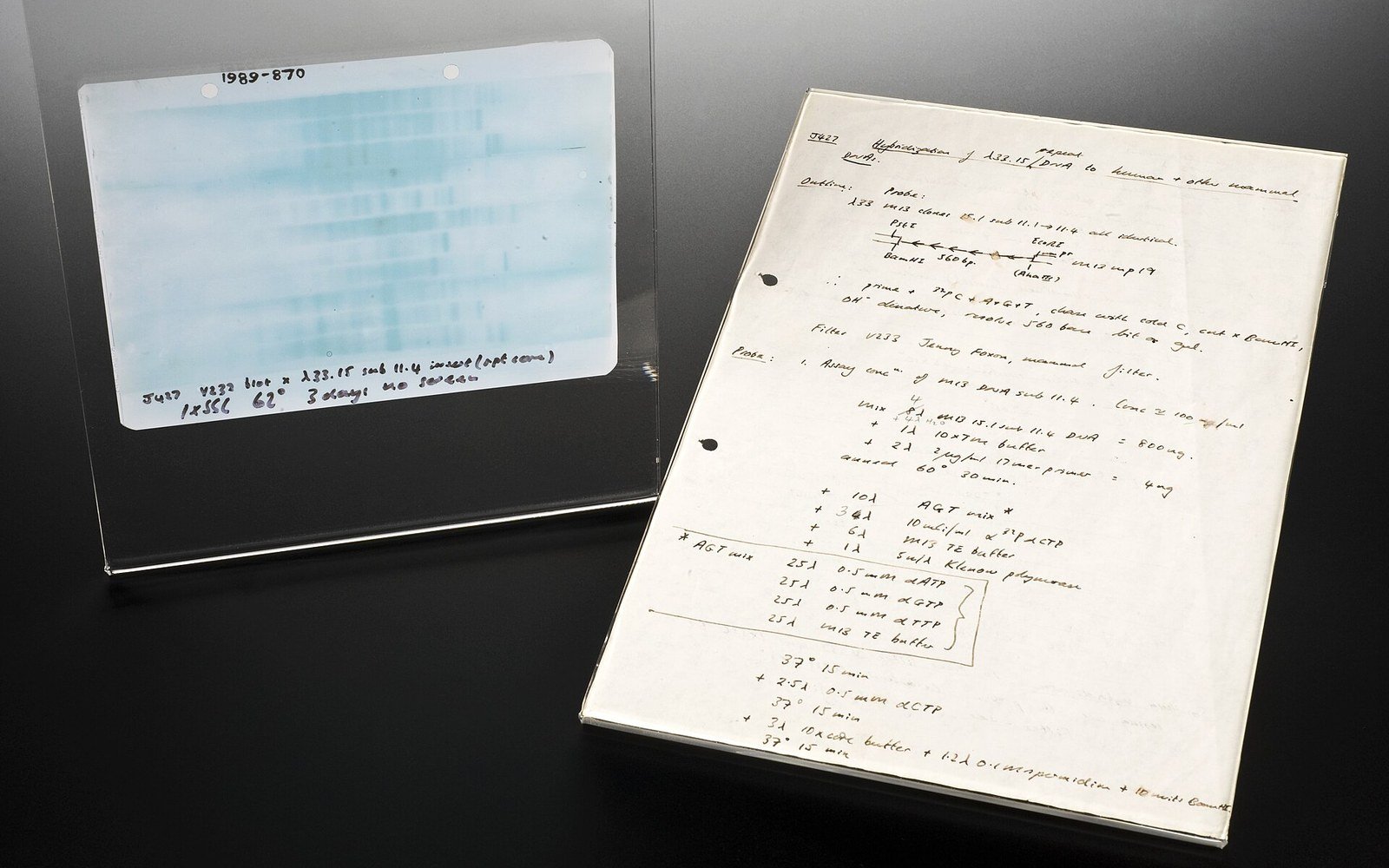
For the first decade of forensic DNA work, separation meant a slab of gel — poured, polymerized, loaded by hand, run for hours, and read from a photograph or a film. The capillary array replaced that slab with a bundle of fine polymer-filled tubes, each roughly the diameter of a human hair, held together in a single cartridge that clips into an automated instrument.
The physics is the same as gel electrophoresis: DNA fragments are small, negatively charged molecules that migrate through a polymer matrix toward a positive electrode, with shorter fragments travelling faster. What changes is the geometry. A narrow tube dissipates heat far more efficiently than a wide slab, which means the voltage can be raised substantially without distorting the separation. Higher voltage means faster runs — typically twenty to forty minutes per injection rather than several hours — and the tight, reproducible separation that capillary electrophoresis demands for reliable allele calling.
Detection happens at a window partway along each capillary. The PCR products loaded into the instrument carry fluorescent dye labels, and a laser fires across all capillaries at the window simultaneously. As each fragment passes through the beam it emits light at a wavelength determined by its dye, and a camera captures that signal continuously. The output is not a photograph but a stream of intensity data, processed into the coloured peak patterns — the electropherogram — that analysts read. Because different dye colours can be separated optically, several STR loci labelled with different dyes run through the same capillary at the same time, allowing a full multiplex profile in a single injection.
The instrument most associated with this shift is the Applied Biosystems family of genetic analysers — the 310 (a single capillary), then the 3100, 3130 and 3500 series — which became the standard platforms in forensic laboratories globally through the late 1990s and 2000s. The National Institute of Standards and Technology ↗ maintains the reference materials and size standards that give every laboratory's instrument a common calibration, ensuring that an allele called at one site can be compared against a database entry produced on a different machine in a different country. SWGDAM ↗ and ENFSI both frame their interpretation guidelines around the electropherogram as the primary record.
Before each run the capillary is flushed and refilled with fresh polymer, so no sample contaminates the next. That self-renewing design also reduces the manual steps where errors accumulate. The transition from slab gel to capillary array is, in practical terms, what made high-throughput database work possible — not a change in the underlying science, but a change in what the science could produce at scale.