The Instruments/Entry 5.02/One technique, and what it can and cannot carry
The thermal cycler
A block that heats and cools on a schedule is the machine that made everything after it possible.
The instrument behind amplification
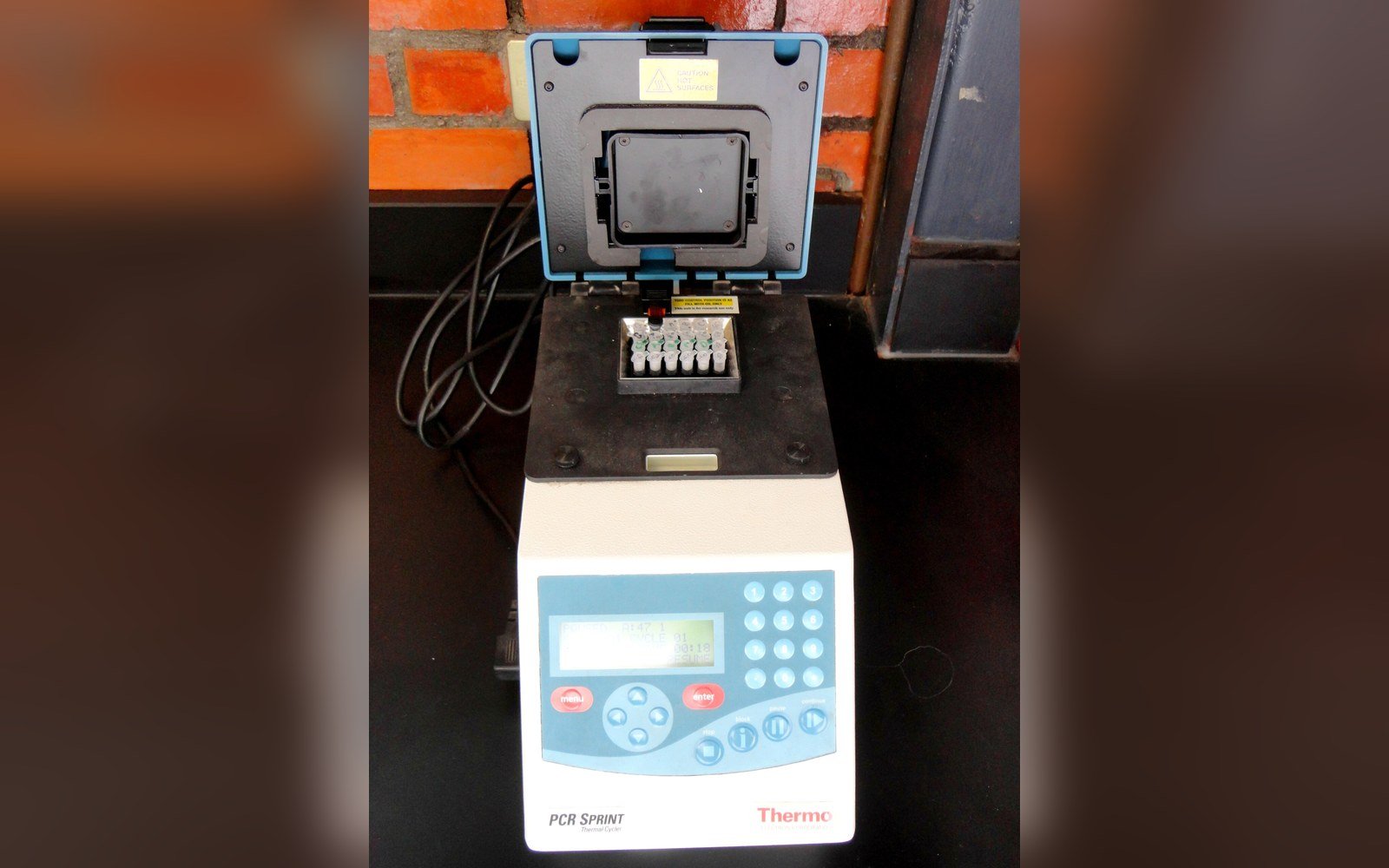
Kary Mullis conceived the polymerase chain reaction in 1983, but a concept is not yet a machine. PCR demands that a sample be heated to around 94 °C to separate the two DNA strands, cooled to 50–65 °C so short primer sequences can bind, then raised to 72 °C for a heat-stable polymerase to copy the target region — and that this three-step cycle repeat twenty-eight to thirty-five times without human intervention. The thermal cycler is the instrument that does that automatically, holding each temperature with precision and moving between them in seconds.
Early PCR reactions were run by hand, moving tubes between water baths at different temperatures. The first commercial thermal cyclers appeared in the late 1980s, marketed by Perkin-Elmer, whose collaboration with Mullis and Cetus Corporation brought the instrument to laboratories. The critical enabling ingredient was Taq polymerase, the heat-stable enzyme isolated from Thermus aquaticus, a bacterium found in Yellowstone hot springs: without an enzyme that survived the denaturation step, a fresh dose of polymerase would have been needed after every cycle, making automation impossible. Mullis received the Nobel Prize in Chemistry in 1993 ↗ for the underlying chemistry.
The engineering inside a thermal cycler is a metal block — typically aluminium or silver — machined to accept a standard 96-well plate or individual tubes. Peltier elements beneath the block drive both heating and cooling electrically, replacing earlier designs that used water or compressed gas. A feedback sensor reads block temperature continuously and adjusts power to hold the setpoint; modern instruments achieve temperature uniformity across a 96-well plate within a fraction of a degree, which matters because even small variation shifts the efficiency of amplification and the ratio of products, a concern that becomes acute in low-template DNA work where one or two extra cycles can produce artefacts.
Forensic laboratories run STR multiplex kits — sets of primers targeting fifteen or more short tandem repeat sites simultaneously — in the same instrument used across molecular biology. The cycler itself is not forensic-specific; what is forensic-specific is the validated kit, the defined cycle count, and the documented protocol the analyst follows. SWGDAM guidelines and the Forensic Science Regulator ↗'s codes both require that cycling conditions be recorded as part of the case file, because deviations from the manufacturer's validated parameters can affect the profile produced.
The thermal cycler is unremarkable to look at — a bench-top box with a lid. Its significance is that it turned a reaction requiring constant human attention into a reproducible, documentable process that could run overnight and be audited the next morning.
From the register
Timeline of key moments
- 1983Mullis conceives PCR
- Late 1980sfirst commercial thermal cyclers reach laboratories (Perkin-Elmer / Cetus)
- 1993Mullis awarded Nobel Prize in Chemistry
- PresentPeltier-element instruments standard in forensic labs worldwide